
Reviewed · SKIP-THE-LINE TICKETS
Skip-The-Line: Group & Private Ephesus Tour Entry Fee & Lunch
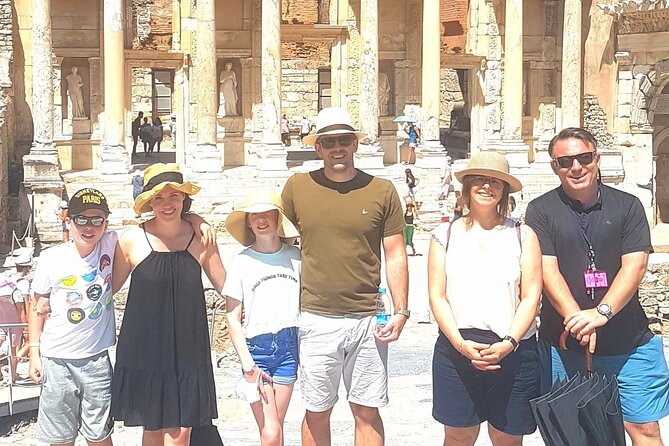
Ephesus is the star here, with its marble streets, enormous theater, Library of Celsus, and traces of daily Roman life. I like the way this tour combines the ruins with air-conditioned transport and a Turkish lunch, two practical comforts on a hot Aegean day. I also like the cruise-port timing guarantee, since missing your ship is the one souvenir nobody wants.
The catch is the shopping portion. The carpet village and pottery stops can be interesting, but you may face a firm sales pitch for costly rugs or ceramics. The House of Mary is also a faith-based site built on tradition and belief, not firm historical proof, so you should know what kind of visit you are choosing.
Key points to know before booking
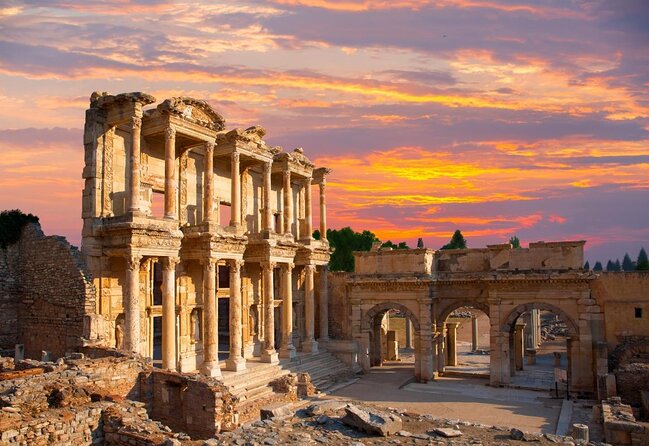
- Ephesus gets the most time: About two hours cover the Library of Celsus, theater, marble streets, gates, fountains, and other major ruins.
- Cruise timing is the main selling point: Pickup and return are matched to your ship’s schedule, with a stated on-time return guarantee.
- You can choose ticket handling: The ticket-included option covers Ephesus entry and skips the ticket queue, while the lower advertised price excludes admission.
- Lunch comes with a shopping stop: Expect a Turkish meal at a carpet village and a chance to see rugs made by hand, along with possible sales pressure.
- The day mixes archaeology and religion: The Temple of Artemis and Ephesus are ancient sites, while Mary’s House is a place of Christian devotion.
- Private means private: On the private option, only your own party takes part, and the guide can adjust the pace and interests.
What the $7 price really means
The advertised price of $7 per person is a starting figure, not the full cost of every version of the tour. You need to select carefully between entry tickets included and entry tickets excluded, and between group and private arrangements.
The ticket-included option is the easier choice. Your guide has the tickets ready, so you avoid the ticket queue at Ephesus. That matters when a cruise ship releases a large number of people at once, or when the sun is already beating down on the entrance plaza.
If you choose the ticket-excluded option, the stated Ephesus admission is €40 per person. The House of the Virgin Mary costs an additional 500 Turkish lira per person. You can pay for these fees by cash or credit card on the day, and the operator says you may pay the guide for skip-the-line tickets.
The value is strongest when you compare the full package rather than the headline figure. You receive port pickup, a licensed guide, an air-conditioned vehicle, lunch, and several major sights in four to six hours. One satisfied customer calculated that the package cost less than arranging transport, entry fees, and meals independently. Still, confirm the exact total before paying, especially if you are comparing the private option.
More Skip-the-Line Tickets in Ephesus
- All Inclusive Private Access Ephesus Tour (SKIP-THE-LINE)
★ 5.0 · 843 reviews - PRIVATE Ephesus and House of Virgin Mary Tour (Skip-The-Line)
★ 5.0 · 558 reviews - SKIP-THE-LINE: Group or Private Ephesus & Artemis Tour with LUNCH
★ 5.0 · 462 reviews
Meeting your guide at Kuşadası Port
The tour begins at the cruise port. At the reservation time, look for a board showing your reservation name in the port exit area. Pickup and drop-off are available from Kuşadası Port only, so this is designed for cruise passengers, not for hotel pickup around the wider region.
The company adjusts the starting time to your ship’s docking and boarding schedule. It also gives a stated guarantee that you will return to the port on time. That is a major practical advantage, though you should still keep the ship’s all-aboard time handy and tell your guide if your schedule changes.
One useful sign of flexibility is the response to a cruise arrival change. A group whose ship altered its arrival time was able to shift the tour with the guide. That kind of communication matters more than a polished brochure when your day depends on a ship’s timetable.
The experience is offered in English. Past guides praised by name include Oscar, Tay, Adam, Vedat, Charlie, Arzu, Ceyda, Erdam, Utdu, and Yesra. Guide assignments can change, so you should not book expecting one particular person unless the company confirms it.
Ephesus, where the day earns its keep
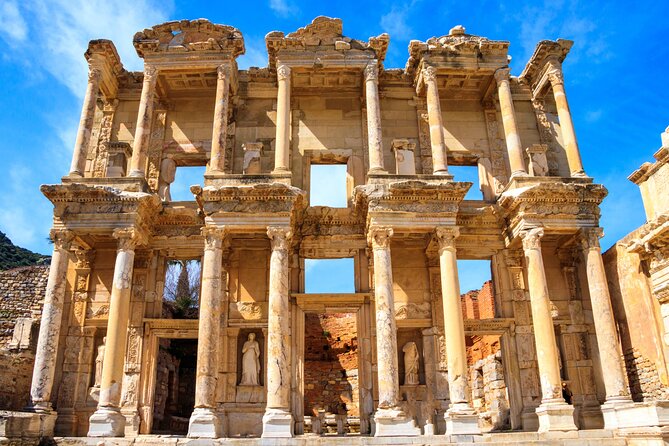
You spend about two hours in Ephesus, and this is the part I would protect if time gets tight. The ancient city gives you the grand monuments, but the guide’s explanations help connect them to ordinary civic life.
The city grew into a major Roman port with a population described in the tour material as more than 250,000 in the first century BC. Its position near the coast helped it become a major center of trade and public life. The harbor has shifted over time, but the old Harbor Street still points toward the city’s former connection with the sea.
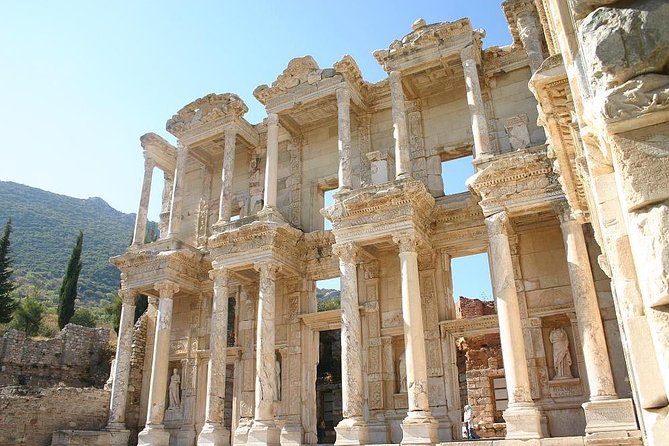
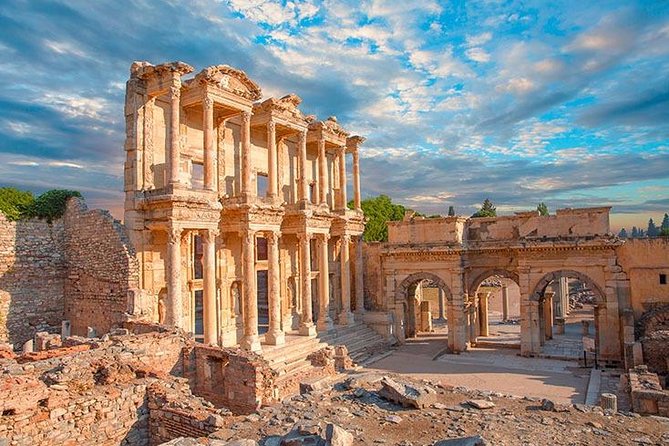
The Library of Celsus is the famous photo stop. Its restored facade gives you a strong sense of Roman public architecture, even though the library itself was not preserved intact. Your guide may also point out a small, lesser-known feature around the library, a secret door that one recent customer specifically wished they had asked about.
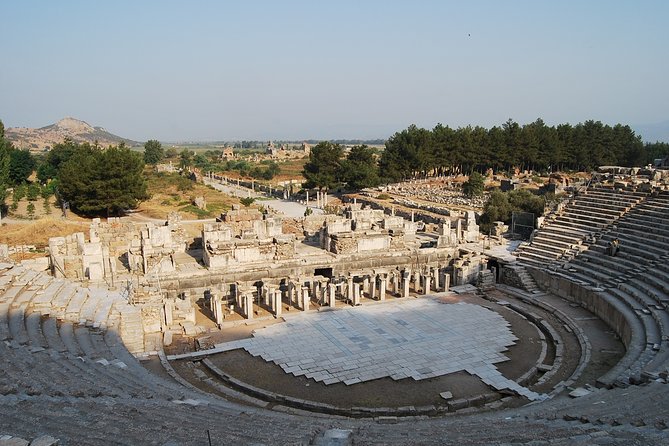
The Great Theater is another major sight. It could hold more than 25,000 people, making it a useful reminder that Ephesus was not a quiet provincial settlement. It was a huge city with public entertainment, politics, trade, and religious ceremonies all packed into one urban center.
Along Marble Street, look for the remains that reveal how people moved through the city. Hadrian’s Gate marks one of the best-known entrances, while the image of Nike gives you a glimpse of the symbols used to honor victory and power. The local pharmacy reference is a small but engaging detail, especially if you enjoy seeing how ancient public spaces served everyday needs.
The ground is uneven, and the ruins include steps. One guide, Oscar, was praised for helping people over difficult sections while leaving time for photographs. If you have mobility concerns, tell the company in advance. The tour can accommodate most people, but Ephesus is still an archaeological site, not a smooth museum floor.
The Prytaneion, sacred fire, and city government
Behind the Basilica, the Prytaneion gives you a closer look at the civic side of Ephesus. Religious ceremonies, official receptions, and banquets took place here. The city’s sacred flame was kept burning in the ceremonial hall, symbolizing the heart of Ephesus.
The building began in the third century BC during the reign of Lysimachos, while the ruins visible today include later work from the Augustan period. A square pit marks the place of the sacred fire. The red floor area helped identify its position during excavation.
This is a short stop of about ten minutes, but it rewards attention. The columns and courtyard are easy to pass without context. With a good guide, you can picture the building as an active public center rather than a scatter of stones.
Archaeologists found two statues of Artemis here. They are now displayed in the Ephesus Museum, not at the ruin itself. That distinction is useful because it explains why the original decoration may be missing from the site.
A completely different sort of day out, same corner of Turkiye:
- FOR CRUISERS: Skip The Lines PRIVATE EPHESUS TOUR &On Time Return
★ 5.0 · 8,527 reviews - Top Choice For Cruisers: Ephesus, Mary’s House WITH TICKETS+LUNCH
★ 5.0 · 7,233 reviews - PRIVATE EPHESUS TOUR FOR CRUISERS: On-time Return and Skip-Line
★ 5.0 · 5,807 reviews - PRIVATE NO HIDDEN FEES Ephesus, Mary’s House Guided Tour /GRP OPT
★ 5.0 · 2,455 reviews
Fountains, baths, and the working city
The Fountain of Pollio is a quick stop, usually about five minutes, yet it helps explain how Ephesus functioned. Water reached the city through aqueducts from three main sources: Kencherios near Kuşadası, the Marnas stream by Çamlık village, and the Cayster River.
Baked clay pipes distributed water to public fountains, where it was free for city residents. In hot weather, these fountains offered both drinking water and relief from the heat. The fountain once carried statues, including a head of Zeus and a group showing Odysseus and Polyphemus. Those pieces are now in the Ephesus Museum.
The Baths of Varius, also a short stop, show the Roman habit of separating bathing by temperature. The complex had a cold-water frigidarium, warm-water tepidarium, and hot-water caldarium. The building dates to the second century AD, while mosaics in its long corridor are from the fifth century.
Excavation is not complete, which means you see a site still being studied. I like these smaller stops because they prevent Ephesus from becoming only a parade of famous facades. They show water, bathing, ceremony, and public service, the systems that made a large ancient city work.
Lunch at the carpet village
The included lunch takes about an hour at a local carpet-weaving village. You can eat a traditional Turkish meal and watch artisans work on handmade rugs. Cold apple tea has been served during the visit, and the food has been described as plentiful and delicious.
This is a pleasant cultural break after the ruins, particularly because the vehicle gives you a cool place to recover from the heat between stops. It also introduces a traditional craft that is difficult to understand from a shop window alone. Seeing the weaving process gives the carpets a human and technical side.
You should also know the commercial angle. The stop may include a presentation and a strong attempt to sell expensive rugs. One customer enjoyed learning about the craft but found the sales pressure too much. Another described the products as beautiful while warning that the prices can be high.
My advice is simple: enjoy the meal and demonstration, but do not feel obliged to buy. If you are not shopping, say so politely and clearly. If shopping is part of your interest, ask about price, materials, knot count, shipping, and return terms before getting carried away by the presentation.
Some versions of the day also include a pottery or ceramic stop. There, you may see Turkish ceramics being made, and one recent participant even had the chance to try the potter’s wheel. These extras can be enjoyable, but they add to the commercial part of the day.
The Temple of Artemis and Mary’s House
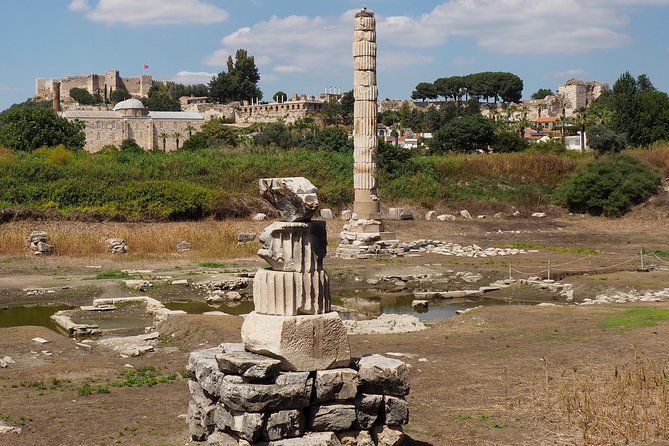
The Temple of Artemis takes about fifteen minutes. It was one of the Seven Wonders of the Ancient World, dedicated to Artemis, the Greek goddess later associated with Diana. Today, the remains are limited compared with the scale of the original temple, so you need to set your expectations correctly.
This stop works best when your guide explains what once stood there and why the temple mattered. It is not as visually complete as the Library of Celsus, but its historical importance is enormous. You are looking at the remains of a building that once drew attention across the ancient world.
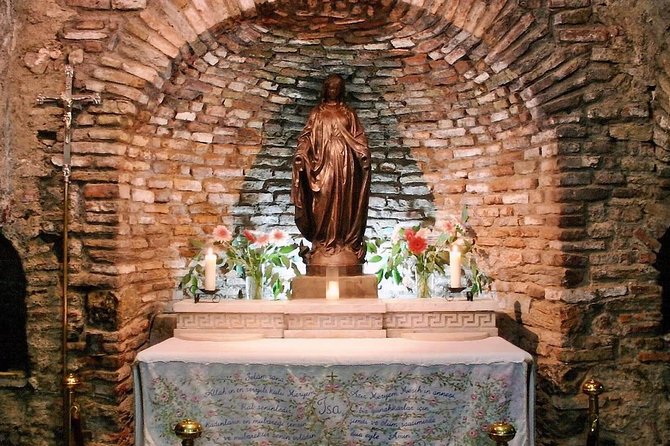
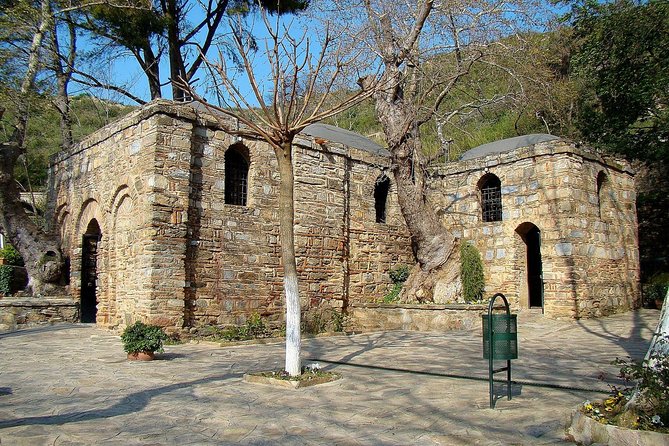
The House of the Virgin Mary takes about forty-five minutes. According to Christian belief, Mary lived near Ephesus with Saint John during the years 37 to 45 CE, and this small house is treated as the place where she spent her final years.
The site is meaningful for many people, but the identification is based on belief and tradition. If you want a strictly archaeological day, this may feel less satisfying than Ephesus. If you value religious places, quiet reflection, or Christian pilgrimage sites, it can be a moving addition.
The entrance fee is separate at 500 Turkish lira per person unless your selected arrangement states otherwise. Make sure you know this before departure so the final cost does not surprise you.
Transport, pace, heat, and group size
The vehicle is fully air-conditioned, which is not a minor luxury in the summer. Ephesus has little shade, and one customer specifically advised bringing plenty of water and something to cover your head. You should wear practical shoes and expect uneven ground.
The duration is about four to six hours. That range reflects the cruise schedule, traffic, group size, and the amount of time you spend at each place. The private option gives only your party the vehicle and guide, and it offers more room to adjust the pace.
Small groups can make a real difference. A group of four described the minibus as comfortable and appreciated being able to discuss choices with the guide. A private tour also lets you spend more time at Ephesus or reduce time at the shopping stops, although the exact flexibility should be confirmed when booking.
The guides are the strongest part of the experience. Adam was praised for his energy and warmth, while Charlie was described as highly informed and personable. Arzu handled a cruise-time change well, and Vedat received praise for patience with mobility limits. Those details suggest that a good guide can turn a packed schedule into a relaxed day.
The one missing convenience is a whisper system. At least one person wished for headsets so the guide could be heard while the group moved around the ruins. In a noisy archaeological site, you may need to stay close to the guide or ask for a repeat.
Who should book this Ephesus day?
I would recommend it to cruise passengers who want the major sights without arranging transport, tickets, lunch, and timing on their own. It also suits you if this is your first visit to the area and you want a guide to explain what you are seeing rather than simply walk through the ruins alone.
Families and mixed-age groups may appreciate the private vehicle and the option to adjust the pace. It can also work well for people who dislike planning around ship departure times, since pickup and return are built around the cruise schedule.
I would be more cautious if you want a pure archaeology tour. The carpet village, possible pottery stop, and House of Mary make this a broad introduction to the region, not a focused study of ancient Ephesus. You may enjoy those stops, but you should not assume they are optional unless the private guide confirms it.
Free cancellation is available until 24 hours before the start time. After that, cancellations and changes are not accepted for a refund. The tour also needs a minimum number of participants and good weather, with another date or a full refund offered if the operator cancels for either reason.
Should you book it?
Book this tour if you want efficient port logistics, a licensed English-speaking guide, a cool vehicle, lunch, and a wide sample of Ephesus and nearby sights. The strongest value comes from choosing the ticket-included option and using the private format if your budget allows.
Skip it if you dislike sales presentations or want every minute devoted to ruins. In that case, ask for an archaeology-focused version or confirm in advance that the carpet and pottery stops can be removed. For most cruise passengers, though, this is a practical and well-rounded way to see Ephesus without gambling on the ship’s return time.
FAQ
Is this tour designed for cruise passengers?
Yes. Pickup and drop-off are available from Kuşadası Port, and the starting time is adjusted to your cruise docking and boarding schedule.
How long does the experience last?
The full experience takes approximately four to six hours, depending on the cruise schedule, traffic, group size, and time spent at each stop.
Are Ephesus entrance tickets included?
Only with the entry tickets included option. If you choose entry tickets excluded, the stated Ephesus admission is €40 per person.
Is the House of the Virgin Mary included?
The House of the Virgin Mary visit is part of the schedule, but its entrance fee is listed separately at 500 Turkish lira per person.
Is lunch included?
Yes. Lunch at a carpet-weaving village is included. Beverages are not included, and the stop may include a presentation and sales pitch for handmade carpets.
Is the tour private?
The private option is only for your own party. The experience also offers a group format, so check the option you select when booking.
What happens if the tour is canceled?
If the minimum number of participants is not reached or poor weather causes cancellation, you will be offered another date or experience, or a full refund. You can also cancel for a full refund up to 24 hours before the start time.
Newest Ephesus trips on the site
- Best Turkey 8-Day Tour: Istanbul, Cappadocia, Pamukkale, Ephesus★ 5.0 · 21 reviews
- 7 Days Highlights of Turkey Tour: Istanbul, Cappadocia, Pamukkale, Ephesus★ 4.5 · 17 reviews
- Turkey Flyer 8-Day: Istanbul, Pamukkale, Cappadocia, Ephesus★ 4.5 · 25 reviews
- Wonders of Turkey – Gulet: Istanbul, Cappadocia, Ephesus, Fethiye★ 5.0 · 51 reviews
- 10 Days Turkey Tour to Istanbul, Cappadocia, Antalya, Ephesus★ 5.0 · 16 reviews
- All Inclusive Private BODRUM to Ephesus, Mary’s House, Lunch Tour★ 5.0 · 17 reviews
- Full-Day Tour from Bodrum to Ephesus★ 4.0 · 19 reviews
- 1 Day Ancient City Ephesus and House Virgin Mary Trip from Bodrum★ 4.0 · 21 reviews
Skip-the-Line Tickets, compared.
Basilica Cistern Skip-the-Line Entry & Audio Guide
Our review →
Istanbul E-pass: Top Istanbul Attractions with Skip The Ticket Line
Our review →Browse the lists this tour appears in